Introduction
Web Summit 2025 made one thing crystal clear: AI is no longer optional for startups—it's essential for survival.
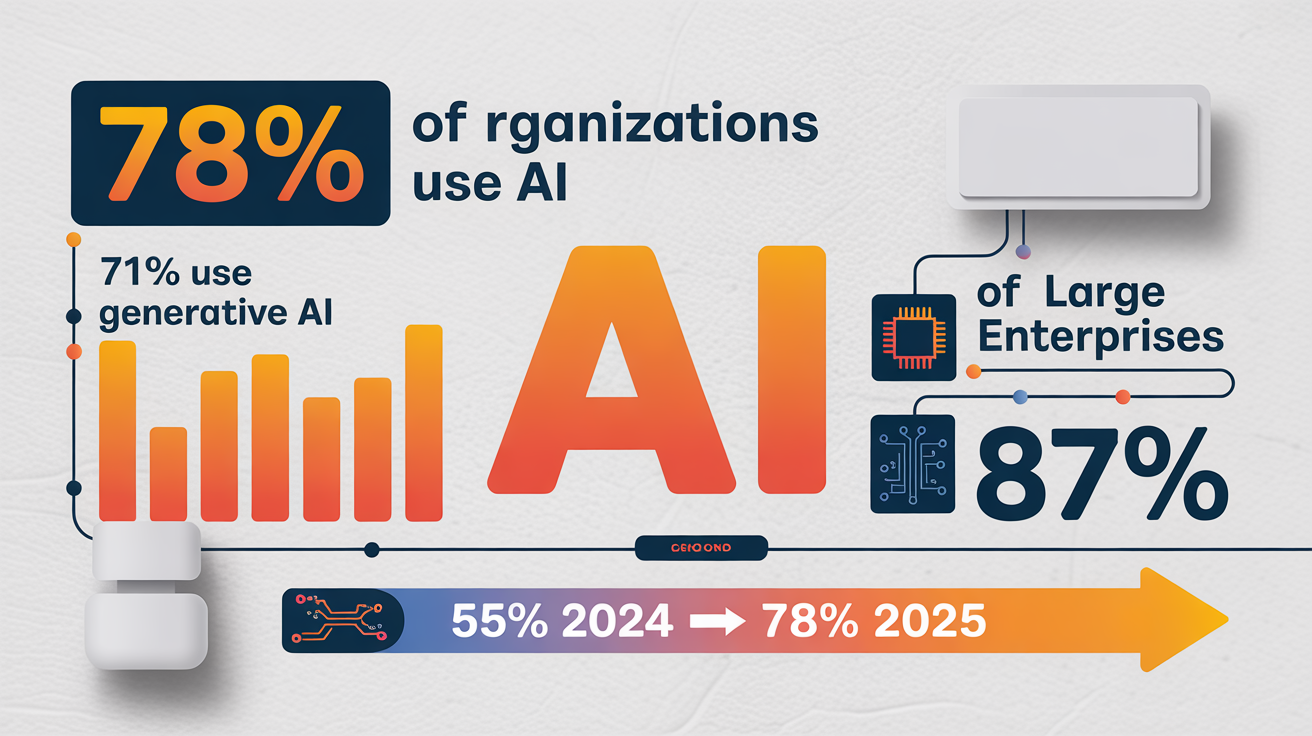
The numbers prove it: 78% of organizations now use AI (up from 55% in 2024), with the global AI market at $391 billion and projected to hit $1.81 trillion by 2030.
For startups, the reality is stark: Founders leveraging AI strategically achieve product-market fit 2-3x faster than their non-AI competitors. Investors now ask "How are you using AI?" instead of being impressed by AI features alone.
This guide breaks down the major AI trends from Web Summit 2025 and provides actionable strategies you can implement immediately.
1. Generative AI Has Matured (And It Shows Real ROI)
Generative AI isn't experimental anymore. 71% of organizations now use it, and companies report a 3.7x return for every dollar invested in AI.
Real-world impact:
- AI-powered product recommendations increase average order value by 15-25%
- AI chatbots reduce customer support costs by 40-60%
- Demand forecasting AI reduces overstocking by 18%
- Contract review automation saves 50-70% of attorney time
- The winning startups aren't using fancy AI models—they're solving real business problems with AI.
2. Enterprise AI Adoption Is Accelerating (Huge B2B Opportunity)
87% of large enterprises have adopted AI, creating massive opportunities for B2B startups:
- 74% of large organizations (1,000-10,000 employees) use AI
- 75% of mid-market (250-999 employees) are implementing AI
- Only 34% of small businesses (50-249 employees) have adopted AI yet
Translation: There's a massive gap for B2B startups selling AI solutions to underserved SMBs and mid-market companies.
3. AI-Powered Personalization Is Now Table Stakes
Customers expect personalization. AI enables startups to compete with enterprise incumbents:
- Personalized email: 25-35% higher open rates, 3-5x higher conversions for behavior-triggered emails
- Product recommendations: 15-25% increase in average order value
- AI chatbots: 15% conversion rate increase during peak sales (Black Friday 2024 data)
- Customer retention: 30-40% churn reduction through personalized retention campaigns
Real example: Shopify merchants using AI Magic report 15-25% AOV increases and 40-60% reduction in support time.
4. The AI Adoption Reality (Key Statistics)
Who's adopting AI:
- 78% of organizations use AI in at least one function
- 71% use generative AI specifically
- 92% plan to invest in GenAI over next 3 years
- 89% expect full GenAI adoption by 2027
Where the gaps are:
- 73% report data quality as their biggest challenge
- 64% of founders cite "finding AI talent" as their #1 blocker
- 67% of jobs now require AI skills
Investment reality:
- Average enterprise AI budget: $6.5M annually
- But 95% allocate less than 20% of IT budgets to AI
- Only 4% have crossed the 20% threshold
5. Industry-Specific AI Wins (What's Actually Working)
E-Commerce & D2C Brands
- AI recommendations drive 15-25% AOV increase
- Smart email triggers: 3-5x higher conversion
- Inventory optimization: 18% reduction in overstocking
SaaS & Software
- AI-powered onboarding reduces churn by 20-30%
- Support automation reduces tickets by 40%+
- Predictive alerts help users act before problems arise
Legal Tech
- Contract review automation: 50-70% time savings
- Compliance monitoring prevents regulatory violations
- Client intake automation cuts admin burden
Insurance & FinTech
- FNOL automation (first notice of loss) reduces processing time by 50%
- Coverage gap analysis identifies 15-20% upsell opportunities
- Client retention: 95% profit growth potential with just 5% better retention
6. AI Implementation Strategy
To implement AI successfully in your startup:
- Identify the problem - Where does AI create most impact in your business?
- Run a pilot - Start with one high-impact, low-complexity use case (4-6 weeks)
- Define success metrics - Measure 3-5 KPIs (efficiency gain, revenue impact, cost savings)
- Choose the right tools - Select based on budget, ease of use, and integration with existing systems
- Train your team - Build basic AI literacy across your organization
- Measure and scale - If pilot succeeds, roll out company-wide
- Iterate continuously - Identify next AI opportunity after success
7. Best AI Tools by Category
| Category |
Top Tools |
Cost |
Best For |
| Email Marketing |
Klaviyo, Active Campaign |
$50-500/mo |
E-commerce, D2C |
| Customer Support |
Intercom, Zendesk |
$50-300/mo |
SaaS, Service businesses |
| Automation |
Make, Zapier |
$10-300/mo |
Any business |
| E-Commerce AI |
Shopify Magic |
$50-300/mo |
Retailers |
| Legal/Compliance |
Spellbook, Ironclad |
$500-5K/mo |
Legal firms |
| General AI Assistant |
ChatGPT Plus, Claude Pro |
$20-40/mo |
Brainstorming, content |
8. AI Compliance & Governance
Why it matters:
- EU AI Act enforces risk-based compliance
- Italy fined OpenAI €15 million for data collection without consent
- Companies face market bans if non-compliant
What to do:
- Document how your AI makes decisions
- Test for bias and fairness
- Implement GDPR/SOC 2/HIPAA compliance (depending on industry)
- Maintain human oversight for critical decisions
Cost: Usually 10-15% of your AI project budget
9. Solving the AI Talent Gap
The challenge: 64% of founders cite "finding AI talent" as their #1 blocker.
Solutions:
- No-code/Low-code platforms - Zapier, Make, Activepieces ($10-300/mo) - no AI engineer needed
- Fractional AI consultants - 10-20 hours/week for $3K-10K/month (vs. $15K+/month full-time)
- Train your existing team - No-code training (1-2 weeks), AI fundamentals ($200-500)
- Outsource development - 40-50% cheaper than in-house hiring
10. What Investors Want to See
If you're fundraising, VCs evaluate:
✅ What impresses investors:
- Clear AI-market fit (solves a real, urgent problem)
- Defensible advantage (proprietary data, unique access)
- Scalable unit economics (AI improves margins)
- Responsible AI practices (compliance, governance)
- Experienced team (at least one AI expert)
❌ What turns investors off:
- "We use AI but don't know why"
- "AI is just a feature, not core to our business"
- "We'll hire AI talent after fundraising"
- "Our competitive moat is just our AI model"
- "We haven't thought about data privacy"
11. Future AI Trends (2026-2027)
- Multimodal AI - Handling text, images, audio, video seamlessly
- Edge AI - Processing on-device for better privacy and speed
- AI Agents - Autonomous systems performing complex, multi-step tasks
- Vertical AI - Industry-specific solutions (legal, healthcare, finance)
- Clearer regulations - EU AI Act compliance frameworks finalized
The Bottom Line
Web Summit 2025 proved: AI adoption is not a future consideration—it's happening now.
The numbers are undeniable:
- 78% of organizations use AI (up from 55% last year)
- Startups with AI hit PMF 2-3x faster
- Companies get 3.7x ROI on AI investment
- 92% of companies plan to invest more in AI
The winners aren't the ones with the fanciest AI models. They're the ones who:
- Clearly understand where AI creates value in their business
- Implement AI in 1-2 core areas and measure ruthlessly
- Prioritize data quality and compliance from day one
- Build AI literacy across their organization
- Communicate their AI advantage to customers and investors
The question isn't whether your startup should use AI anymore. It's: How quickly can you implement AI to build an advantage your competitors can't replicate?
The companies answering that decisively are the ones leading their industries in 2025.