
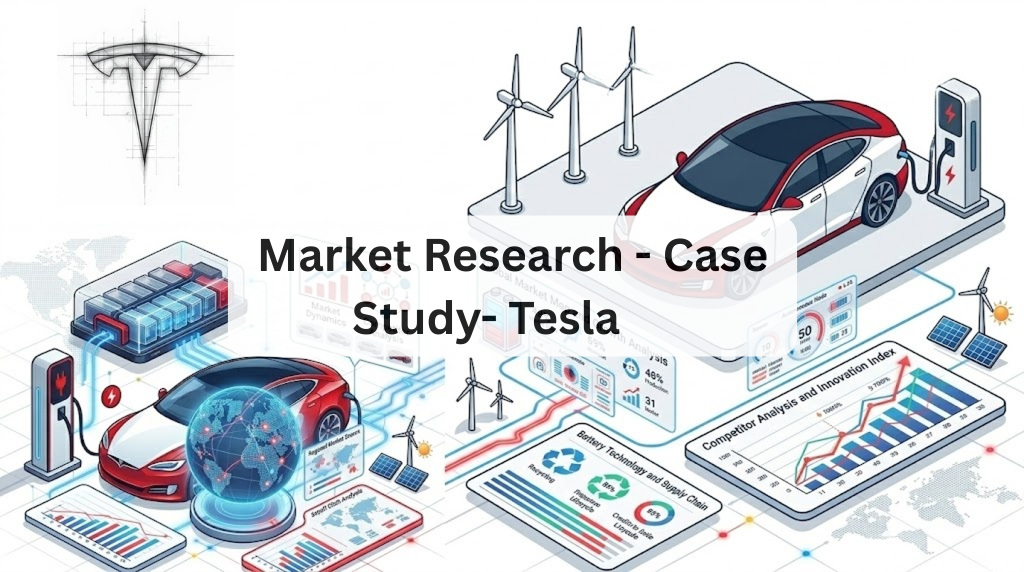
Tesla's strategy is a prime example of how understanding the dynamics of an industry, particularly in terms of technological advancements, consumer trends, regulatory landscapes, and competitor positioning can be used to disrupt and dominate a new market.
When Tesla entered the automotive market in the early 2000s, the landscape was vastly different from what it is today. The automotive industry was dominated by established players like General Motors, Ford, Toyota, and Honda, with a heavy emphasis on internal combustion engine (ICE) vehicles.
· Electric vehicles were seen as impractical, with limited driving range and long charging times
· The traditional automotive industry had very little incentive to pursue EVs, given the established success of gasoline-powered vehicles
· Battery technology was still in its early stages, and there were concerns about cost, energy density, and charging infrastructure
Despite these barriers, Tesla entered the market with a bold vision, to create mass-market electric vehicles and revolutionize the automotive industry. The company needed to understand the industry landscape.
Battery technology was advancing, but electric vehicles (EVs) were still constrained by range anxiety (fear of running out of battery) and long charging times
Tesla focused on creating a premium EV with a long driving range by developing its own proprietary battery technology.
Tesla understood the growing shift toward environmentally conscious consumer behaviour and the desire for sustainable transportation options.
Tesla marketed its vehicles as high-performance luxury cars that also happened to be electric.
Governments worldwide were beginning to pass stricter emissions regulations and providing incentives for clean energy technologies.
Tesla took advantage of these government incentives to offer its vehicles at more attractive prices.
One of the biggest challenges for electric vehicles at the time was the lack of a widespread charging infrastructure.
Tesla took a bold step by building its own network of Supercharger stations to provide fast, convenient charging for its customers.
Tesla’s success wasn’t just about creating a better car; it was also about recognising where competitors in the automotive and technology industries were falling short and how they could be disrupted.
Traditional automakers were hesitant to invest in electric vehicles due to high development costs, low demand, and existing investments in ICE vehicles.
Tesla did not just enter the EV market to compete with other electric car makers, instead, they aimed to disrupt the entire automotive industry by introducing electric vehicles that could outperform traditional gasoline-powered cars.
In 2010, when Tesla launched its Model S, competitors like General Motors (with its Chevrolet Volt), Nissan (with the Nissan Leaf), and other carmakers had made some efforts in the EV space but were not fully committed to transitioning their lineups to electric.
Tesla capitalised on this gap by producing the Model S, a high-end sedan that had more than 300 miles of range per charge. This allowed Tesla to appeal to a completely different market segment with affluent buyers looking for a luxury experience, not just an affordable, eco-friendly vehicle.
Tesla also understood that for sustainable success, it needed to control as much of the supply chain as possible.
Instead of relying on third-party suppliers for batteries, Tesla took the step of building its own Gigafactories to produce batteries at scale.
The establishment of the Gigafactory allowed Tesla to produce batteries more efficiently, which in turn reduced costs and improved vehicle performance.
While other automakers were slowly developing autonomous systems, Tesla took a more aggressive stance, integrating semi-autonomous features like Autopilot into its vehicles.
By integrating a sophisticated suite of sensors, cameras, and software, Tesla differentiated itself from competitors.
Tesla’s approach is based on a deep understanding of industry trends, consumer needs, technology gaps, and competitor weaknesses. Tesla became the leading EV manufacturer, achieving global sales of over 1.3 million vehicles in 2022 and surpassing traditional automakers like Ford, General Motors, and Toyota in market capitalisation.
· Tesla’s focus on cutting-edge battery technology and autonomous driving positioned it as an industry leader in innovation, making it more than just an electric vehicle company
· Tesla capitalised on favourable government policies for EVs and took steps to shape future policies that would benefit its business
· By building its own Gigafactories and controlling key parts of the production process, Tesla reduced costs and gained a competitive edge in manufacturing and technology development
· Instead of just offering an alternative to gasoline-powered cars, Tesla disrupted the entire automotive industry by providing luxury, performance, and sustainability in a single package
For expert funding, mentorship, business growth solutions, and entrepreneur programs, visit: The Entrepreneur Studio
Follow Us:
Facebook – https://www.facebook.com/people/The-Entrepreneur-Studio/61552810916102/
Instagram – https://www.instagram.com/theentrepreneurstudio/
Twitter – https://x.com/T_E_Studio
LinkedIn – https://www.linkedin.com/company/the-entrepreneur-studio/, Manmeet Abroll, Andrew Evans